



La mostra
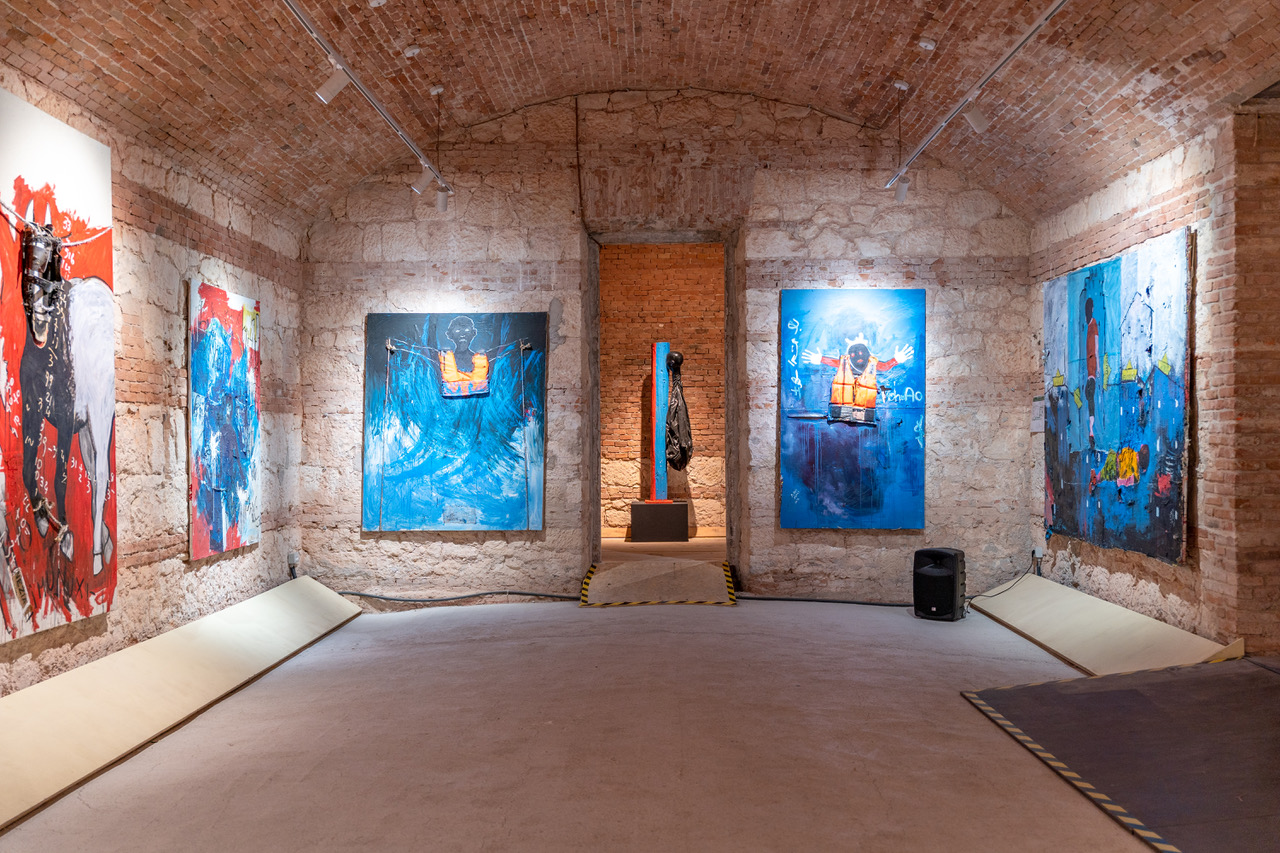
La mostra STOP, non più oltre, dedicata a Maffeo d’Arcole, si inserisce nel palinsesto di Interregno, il progetto culturale promosso da Fondazione Cariverona tra il 2025 e il 2026 che mette al centro una domanda decisiva: che cosa consideriamo “normale” e che cosa definiamo “diverso”? E soprattutto: quali confini – visibili o invisibili – separano ancora queste due categorie, alimentando esclusione, distanza, marginalità?
In STOP, non più oltre, la tensione tra normalità e diversità emerge come un nodo etico: ciò che chiamiamo “normale” può diventare assuefazione all’ingiustizia, accettazione della violenza, abitudine alla sofferenza altrui. Maffeo rovescia questo automatismo e lo rende visibile: mette in crisi l’indifferenza, restituisce presenza agli esclusi, costringe a interrogarsi su dove nasce la distanza tra “noi” e “gli altri” e su quale sia, oggi, la soglia oltre la quale non si può più restare neutrali.
Il confine, nel lavoro di Maffeo, non è mai solo geografico: è morale, storico, umano. Ma è anche – in modo decisivo – un confine culturale: quello che separa ciò che viene riconosciuto “dentro” dal sistema dell’arte
da ciò che resta “fuori”.
Autodidatta, radicato nella sua terra ma con uno sguardo costantemente rivolto al mondo, Maffeo d’Arcole sviluppa da oltre cinquant’anni una ricerca autonoma, laterale, non addomesticata: un’arte che nasce ai margini delle appartenenze ufficiali e che proprio per questo rende visibile, anche sul piano simbolico, la domanda di Interregno su normalità e differenza.
Pittura, scultura, installazione, performance e video convivono in una pratica espressiva che nasce dall’urgenza e dall’indignazione e si traduce in immagini di grande forza visiva. Il suo lavoro non è mai pacificante: inquieta, provoca, interroga.
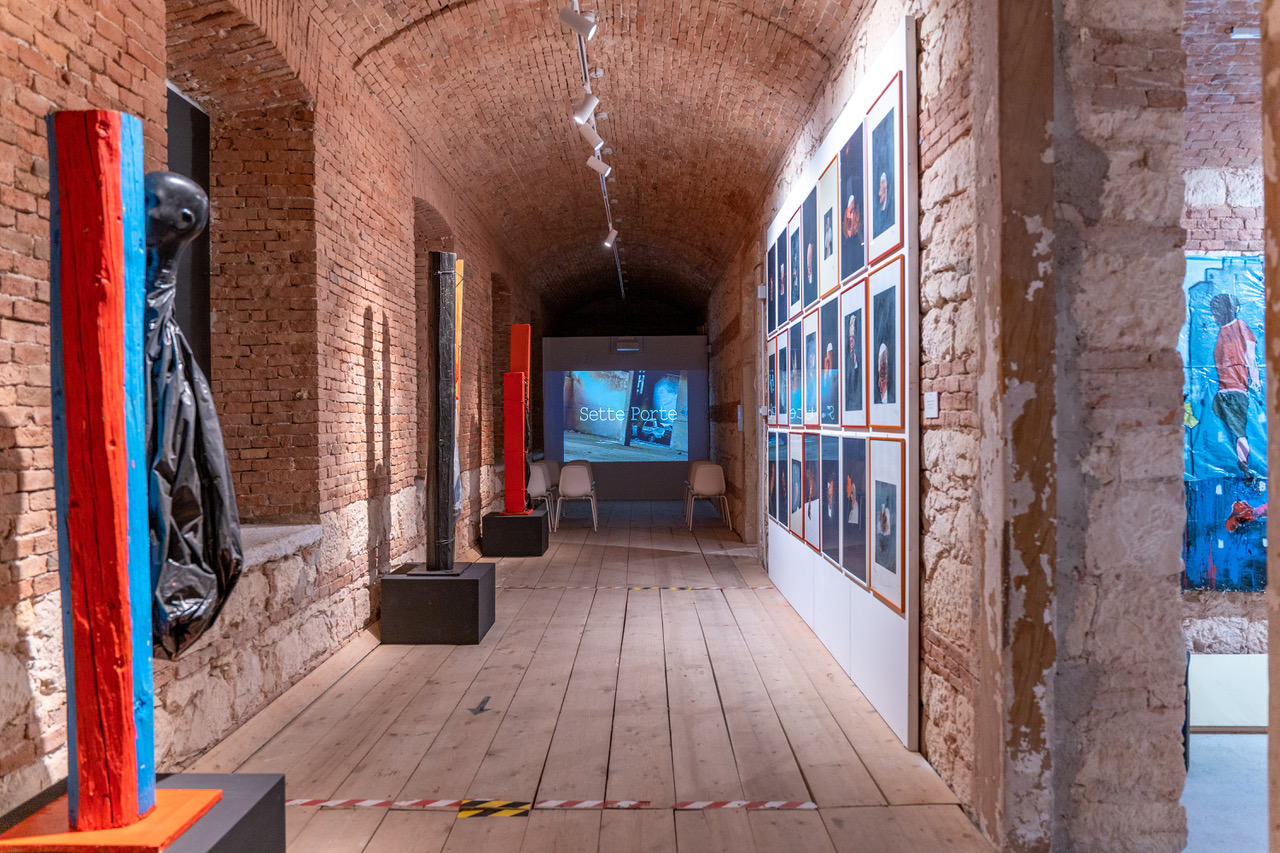
Le sagome lignee dei migranti realizzate con assi di case abbandonate evocano l’emigrazione veneta verso il Sud America e dialogano con le migrazioni contemporanee.
I numeri che attraversano le tele riducono l’uomo a cifra, memento della sua fragilità. Le figure deformate, i colori primari attraversati da neri e bianchi violenti, la materia incisa e stratificata restituiscono una realtà che non concede alibi.
Accanto alla radicalità dello sguardo, la pratica di Maffeo conserva una dimensione essenziale: la coralità.
La sua è un’arte che nasce dal basso, dentro un legame concreto con Arcole e con una dimensione comunitaria: un fare che non isola l’artista in un recinto autoreferenziale, ma lo colloca in una trama di relazioni, memoria e territorio. Anche in questo senso, la mostra a Castel San Pietro si configura come un attraversamento di confini: tra centro e margine, tra riconoscimento e invisibilità, tra storia locale e ferite globali.
La mostra STOP, non più oltre è ulteriormente arricchita dall’apporto del sound design di Luca Richelli realizzato per l’installazione Sand Creek e dal videomapping “ELSEWHERE”, di Enzo Gentile, pensato come dialogo con l’installazione “Popoli in cammino” posizionata all’esterno del castello.
The Exhibition
The exhibition STOP, non più oltre focused on Maffeo d’Arcole is part of the Interregno project, a cultural initiative promoted by the Fondazione Cariverona between 2025 and 2026. The project centers on a crucial question: What do we consider “normal” and what do we define as “different?” Above all, what boundaries, whether visible or invisible, still constrain these two categories, thus fueling social exclusion, alienation, and marginalization?
STOP, non più oltre thus exposes the tension between normality and diversity, which emerges as an ethical dilemma; what we think of as “normal” can become the acceptance of injustice, violence, and of the suffering of others. Maffeo reverses this type of automatic response by making it visible. He challenges our indifference, making us notice those who are excluded, forcing us to question what gives rise to the rift between’us” and “them” and what, today, is the threshold beyond which we can no longer remain neutral.
Borders, in Maffeo’s work, are never merely geographical: they are moral, historical, and human. Yet they are also decisively cultural, separating what is recognized as “inside” by the art system itself from what remains “outside” it.
Self-taught, rooted in his homeland but constantly looking outward, Maffeo d’Arcole has been pursuing an independent, alternate, and untamed way of making art for over fifty years. His is an art born on the margins of establishment affiliations and, precisely for this reason, it visually and symbolically embodies the Interregno project’s query regarding normality and difference.
Painting, sculpture, installation, performance, and video coexist in an expressive endeavor born of urgency and outrage transmuted into images of great visual impact. His work never pacifies, but unsettles, provokes, questions.
The wooden silhouettes of migrants, made of wooden planks from abandoned houses, evoke the Venetians’ emigration to South America while alluding to contemporary migrations.
The numbers across the artist’s canvases reduce humans to ciphers, reminding us of their fragility. The deformed figures; the primary colors streaked with violent blacks and whites; along with the engraved and layered materials confront us with a reality that leaves no room for excuses.
The artist’s radical gaze coexists with an essential aspect of his work: collective participation. His art arises from a humble background that is tangibly linked to his hometown of Arcole and its communal dimension. His is a craft that does not isolate the artist within a self-referential enclosure, but places him within a web made up of relationships, memories, and the land itself. In this sense, the Castel San Pietro exhibition may be viewed as configuring a crossing of boundaries between the center and margin; recognition and invisibility; local history and global troubles.
The exhibition STOP, non più oltre is further enhanced by Luca Richelli’s sound design for the Sand Creek installation, and Enzo Gentile’s videomapping ELSEWHERE, which is intended to serve as a dialogic mirror for the Popoli in cammino installation located outside the castle.
Biografia
Maffeo Burati nasce ad Arcole, in provincia di Verona, il 1° aprile 1946.
Dal paese natale, dove tutt’ora vive e opera, mutua anche il nome d’arte.
Ultimo di otto figli di una famiglia contadina, terminata la scuola elementare inizia subito il lavoro dei campi, al quale segue un lavoro da operaio al compimento del sedicesimo anno di età.
Il suo interesse per il disegno e per la pittura si manifesta fin dalla più tenera età. I primi insegnamenti li riceve dal fratello Ruggero, che sarà il suo primo e solo maestro soprattutto nella fase iniziale.
Per un periodo i due fratelli convivono a Verona e qui Maffeo spera di poter frequentare l’Accademia di Belle Arti G.B. Cignaroli che, purtroppo, chiude i propri corsi serali prima che lui si possa iscrivere. Rinuncia obbligata, questa, vissuta dal giovane artista come una delle principali delusioni che ha dovuto patire. Nonostante ciò, ogni suo momento libero continua ad essere dedicato all’attività artistica. In seguito, si iscrive a un corso di teatro a Bologna, un’esperienza di breve durata.
Nel 1969 viene chiamato ad assolvere il servizio militare e al ritorno le sue idee sono più chiare: la strada da intraprendere è per lui solo quella dell’arte.
Maffeo abbandona ben presto i pochi insegnamenti ricevuti e prosegue la sua ricerca in totale libertà.
Se all’inizio i suoi temi di indagine sono quelli del mondo contadino e la tecnica utilizzata è quella più tradizionale, a tratti tendente al naif, quasi subito inizia pure una sperimentazione più ardita, che lo porta a investigare diversi generi artistici e ad utilizzare molti differenti medium.
Abbraccia un linguaggio e adotta uno stile assolutamente personali, con una predominanza della gestualità come pratica pittorica e dell’uso dei colori primari come tavolozza principale.
Come operaio, anni prima, aveva avuto modo di partecipare alle battaglie per i diritti dei lavoratori e ad aprire il suo sguardo su di un orizzonte più vasto di quello fino ad allora vissuto in campagna. Matura così una coscienza politica, un profondo senso di giustizia, un nuovo modo di coniugare i principi acquisiti dalla solida formazione religiosa impartitagli dai genitori con i valori laici di rispetto della vita umana, della dignità della persona e di difesa dei più deboli. Un sentimento forte che lo porta, anche e soprattutto nella pratica artistica, a farsi testimone del tempo in cui viviamo, denunciando, con uno sguardo quantomai vigile, tutte le contraddizioni della nostra epoca.
Pur non avendo frequentato scuole d’arte ed essendo quindi sostanzialmente un artista autodidatta, Maffeo conosce il mondo dell’arte, perché ha visto molto. Fin dall’inizio degli anni Settanta ha regolarmente visitato tutte le Biennali di Venezia e ha visitato la maggior parte delle Gallerie di arte moderna (anche per decine di volte) delle principali capitali d’Europa: Parigi, Londra, Berlino, Praga, Varsavia, Budapest e più a est Mosca. Ha pure visto ciò che si muove in diversi paesi extraeuropei, come Vietnam, Cambogia, Cina, Africa.
Già a partire dalla fine degli anni Settanta, diverse sono le mostre e i momenti pubblici che lo hanno visto protagonista, arrivando a esporre anche in città straniere come Bellinzona e Parigi.
E’ un artista profondamente vocato all’arte relazionale e all’arte partecipativa.
Davvero grande è il numero di persone che abitano ad Arcole, e non solo, che ha saputo coinvolgere nella realizzazione dei suoi film e delle sue performance, nell’allestimento dei presepi e nella teatralizzazione delle manifestazioni religiose.
La sua opera non è mai un oggetto fisso, ma un dispositivo che genera incontri e scambi, così come ha generato incontri e scambi la realizzazione di questa mostra.
Biography
Maffeo Burati was born in Arcole, in the province of Verona, on April 1, 1946.
The artist’s pseudonym derives from his hometown, where he still lives and works.
Born into a family of farmers as the youngest of eight children, after completing elementary school, he immediately began working in the fields and took on a job as a factory worker by the age of sixteen.
He showed an interest in drawing and painting from a very early age and received his first lessons from his brother Ruggero, who would become his first and only teacher, especially during the initial phase of his artistic development.
For a time, the two brothers lived together in Verona, where Maffeo hoped to attend the G.B. Cignaroli Academy of Fine Arts, which, unfortunately, cancelled its evening classes before he could enroll. This forced abandonment of his plans constituted one of the greatest disappointments the young artist had to endure. Despite it, he continued to devote all his free time to his artistic endeavors. He subsequently spent a brief period of time studying theater in Bologna.In 1969, Maffeo was drafted and, upon his return from military service, he had made up his mind: art was the only path for him to follow.Maffeo soon abandoned the limited training he had received and proceeded on his artistic quest in utter freedom.While his initial focus was on the rural world and his technique was more traditional, at times verging on the naive, he soon began to experiment more boldly, exploring diverse artistic genres and employing a wide range of mediums.He embraced a unique language and style, with a predominance of gestural painting and the use of primary colors as his main palette.
As a factory worker years earlier, he had participated in the struggles for workers’ rights, which had broadened his view beyond that of the bucolic life he had led until then. This in turn allowed him to develop a political conscience, a profound sense of justice, and a new way of combining the solid religious principles his parents had imparted to him with the secular values of respect for human life and dignity, as well as the defense of the most vulnerable. It is this strong, heartfelt sentiment that also and especially underpins his work as an artist, making him a witness of the times we live in, whose ever-vigilant gaze denounces all the contradictions of our era.
Although he never attended art school and is therefore essentially self-taught, Maffeo knows the art world well, having seen a lot. Since the early 1970s, he has regularly attended all the Venice Biennales, even paying dozens of visits to the modern art galleries found in our major European capitals, such as Paris, London, Berlin, Prague, Warsaw, Budapest, and Moscow further east. He is also well acquainted with the art scene outside of Europe, including such countries as Vietnam, Cambodia, China, and Africa.Since the late 1970s, he has been the focus of several exhibitions and public events, and his works have also been shown abroad in cities such as Bellinzona and Paris.He is an artist deeply devoted to relational and particpatory art. He has involved a truly large number of people, both from Arcole and beyond, in the making of his films and performances, in the installation of nativity scenes, and in the theatricalization of religious events.His work is never a fixed object, but a device that generates encounters and exchanges, just as the organization of this exhibition has likewise generated encounters and exchanges.